empirica Care Forecast
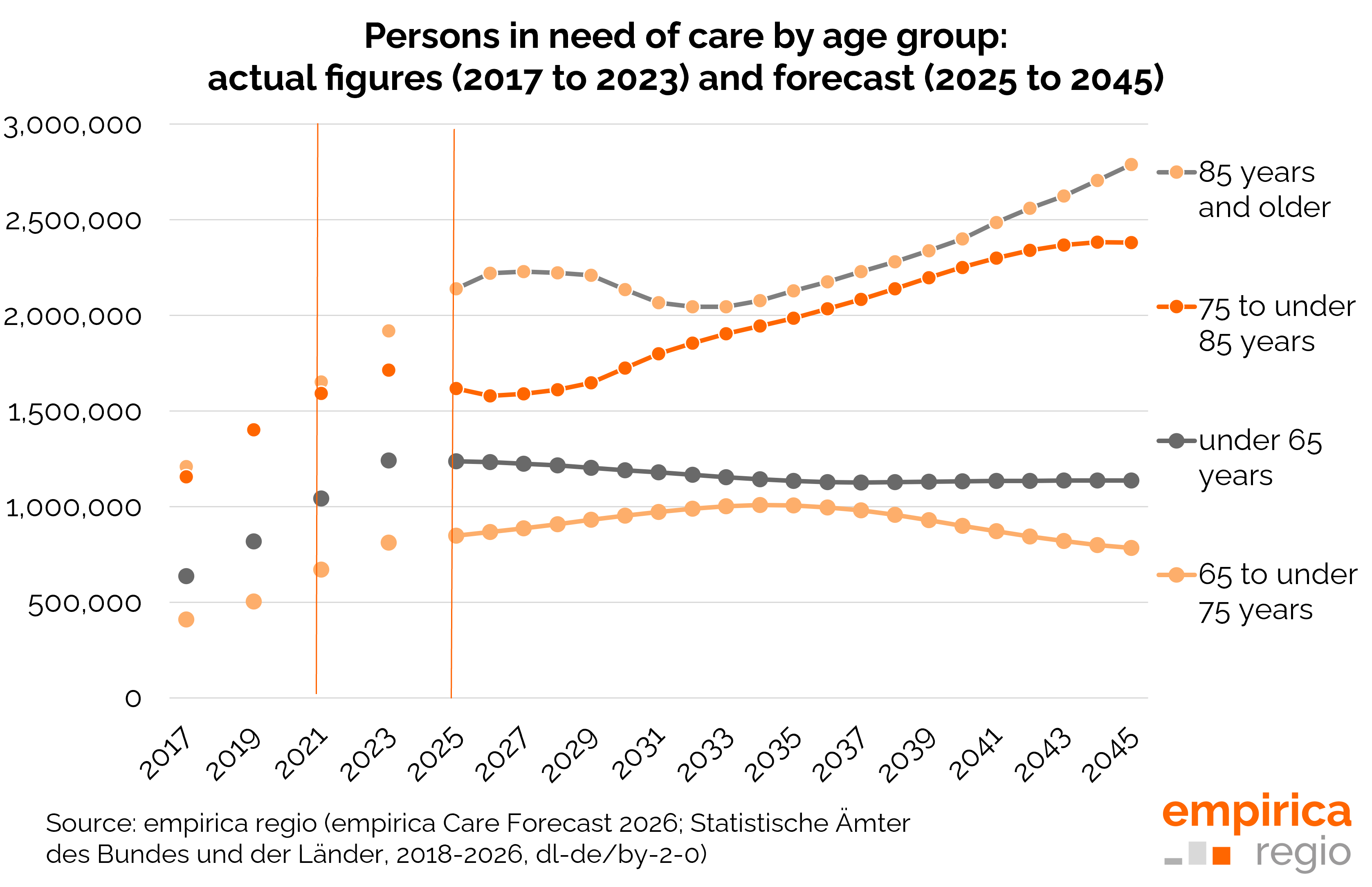
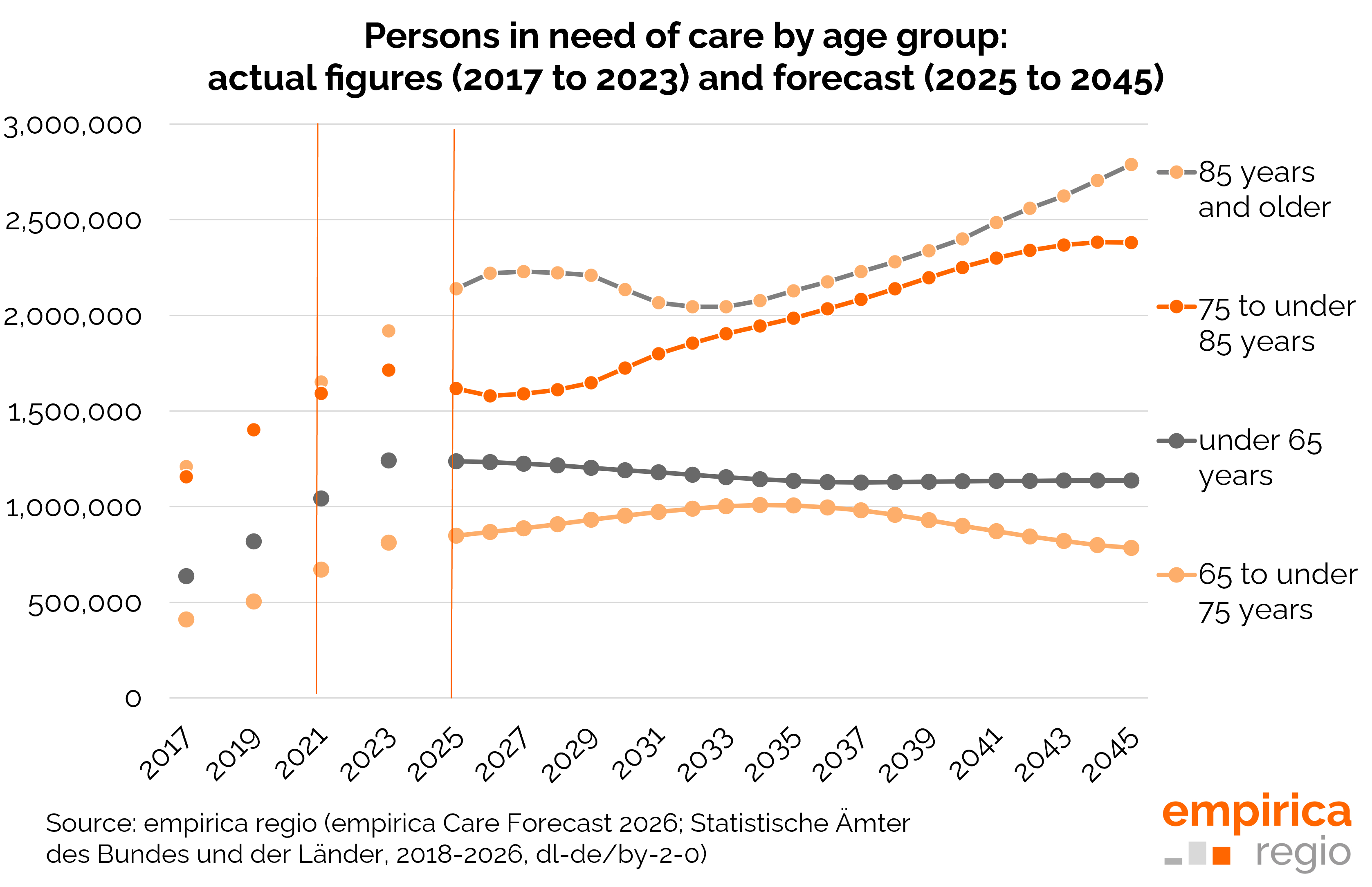
The empirica Care Forecast shows how the number of persons in need of care will develop up to 2045 – for Germany as a whole, the federal states and all 400 urban and rural districts. It distinguishes between age groups and types of care (care allowance, outpatient care, nursing homes).
With unchanged care rates, the number of persons in need of care in Germany is likely to rise from 5.84 million (2025) to 7.09 million (2045), with large regional differences. The forecast reflects demographic development only; it is based on the 2023 care statistics, estimated district-specific care rates and the middle scenario of the empirica population forecast.
Purchase Options
Are you interested in data from the empirica Care Forecast 2026? You can obtain the results of our forecast models and many other data bases from empirica regio as access to the empirica Regional Database (Market Studio and RESTful API ). In addition to access to the forecasts, you benefit from a wide selection of further data. You also gain immediate access to the updated forecasts as soon as they are published.
If you are interested in a consultation appointment or an individual offer to obtain the empirica Care Forecast, please contact us by e-mail at info@empirica-regio.de or by phone at +49 (0) 30 884 795 55.
Detailed results and further information on the methodology can be found in the current empirica paper No. 285, which is available for download on the empirica ag website:
External download: empirica Paper No. 285 (external download, in German only).
Methodology
The empirica Care Forecast calculates the number of persons in need of care up to 2045 for Germany as a whole, the federal states and all 400 rural and urban districts (base year 2023). The forecast distinguishes four care groups: recipients of care allowance, persons receiving outpatient care and full inpatient care, and the group with “care level 1”. The starting point is an observation from earlier empirica studies: age alone does not explain regional differences. The statistical offices of the federal states last published the number of persons in need of care by type of care, age and sex for all urban and rural districts in 2015. In individual districts, the actual number of persons in need of care deviates from the value that would result from national age rates by between minus 40% and plus 70% (as at 2015). National or state-wide care rates can therefore not simply be transferred to the districts.
Since 2017, no differentiated figures have been published across the board at district level. The district-specific care prevalence rates were therefore determined in several steps. The state rates from the care statistics are transferred to the districts, corrected by regression for regional structural differences (settlement structure, location, supply of care services, income, unemployment) and adjusted to the district values observed in 2023. The care prevalence rates, differentiated by age and care group, are then multiplied by the empirica population forecast (middle scenario) and summed up.
The care prevalence rates remain unchanged until 2045. The forecast thus shows, as a reference path, how the number of persons in need of care changes through demographic development alone. Changes in the law, changes in supply and staffing, and a further rise in care rates are not taken into account.